

On Tuesday night, I was impressed by Senior Director of Data and Accountability Richard Smith for walking the school board and community through every school on the district’s closure list. He explained why Sitton stays open in St. Johns, why Lewis is on one list despite its seismic upgrades, and why Marysville’s closure would wait until 2028 so children who already moved once don’t move twice. Hundreds of people pushed into the building to hear it, and many were upset and emotional. The room was supercharged with big-adult-feelings.
I know what that room feels like from where he stood. During the pandemic, I led research and evaluation for Portland Public Schools. My job was to bring the data to the board and the public while our city argued about when to reopen. I learned something in that seat that I want every parent, board member, and legislator to hear before the December vote.
What I learned the last time we waited
We had data showing the small impact of reopening on COVID-19 rates, and we could see districts across the country bringing kids back. Instead of acting, we spent months in public meetings hearing demands for a certainty no one could give, and we waited because reopening felt unjust and inequitable based on community input.
Oregon moved teachers to the front of the vaccine line so schools could reopen, but they didn’t. Meanwhile, public transit bus operators kept showing up to work without access to vaccines. Oregon schools were primarily in person for only 8% of that school year. In Colorado, it was 28%. In Arkansas, it was 87%. The Oregon kids who stayed home longest lost the most.
Waiting was the injustice.
That isn’t only a pandemic story. Oregon has a deep habit of studying a problem, collecting hundreds of hours of public input, forming another task force, commissioning another thick report, and then not acting. It’s why I named this column For the Love of Learning and Action.
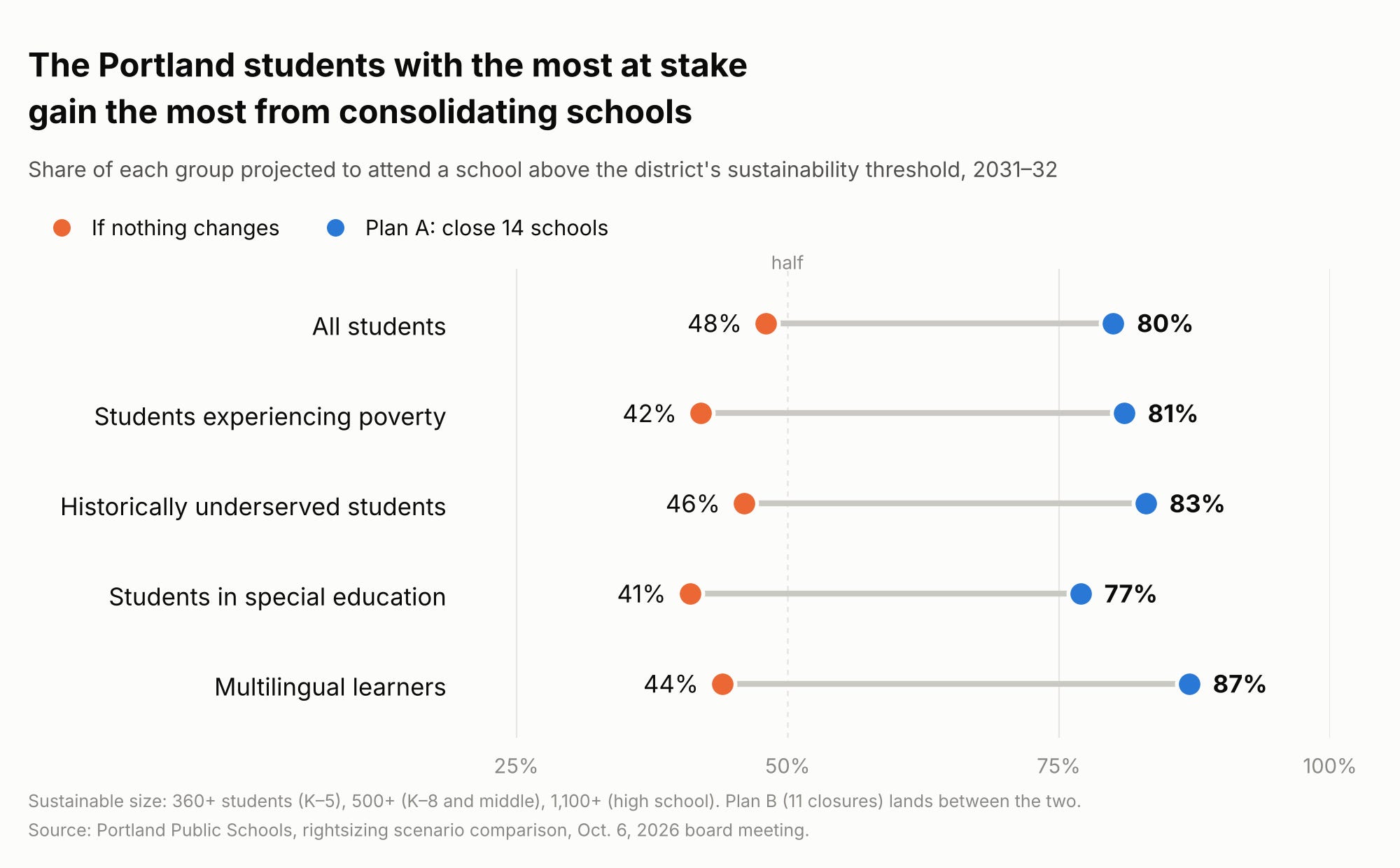
The loudest request on Tuesday was the one I heard five years ago: more time. The district’s own numbers show what more time costs now. If nothing changes, only 42% of Portland students living in poverty will attend a school big enough to staff a full program by 2031. Under the larger plan, which closes 14 schools, 81% would. More time won’t change those numbers.
What families are owed, and what they aren’t
Families are owed an explanation for why each school is on the list and what trade-offs we are making as a community. Some of those reasons and trade-offs are still hard to follow. Board members pressed for detail on busing, savings, and programming, and Dr. Kimberlee Armstrong promised answers by mid-November. That’s the process working. I am proud of how our district and board moved through that discussion this week.
Families also deserve honesty about which students and communities are carrying the weight of these plans. Six of the 10 elementary schools on both closure lists are Title I schools, and a coalition of Title I parents says their communities are bearing the burden. They’re right. But maintaining the status quo puts even more on those same families, and the district owes them meaningful support through any transition to come.
Families are owed a space to voice concerns. As a researcher and as a mom, I have spent 20 years building spaces to listen and learn, and I’ve been impressed by the many opportunities PPS has given families to ask Dr. Armstrong and her team questions. But input and leadership are different jobs. Input tells leaders what a school means to a neighborhood and what the plan might miss. Leadership decides which buildings stay open and how programs are staffed, and it answers for those decisions down the road. That is how our public systems are set up to work, if we trust them.
Families aren’t owed certainty before we decide or build a plan. When a doctor recommends surgery, you deserve to know why, what the risks are, and what happens if you wait. That information, based on medical research and your own data, helps you understand the decision and trust it. But you can’t demand the operating room schedule before you agree to the surgery.
Keri Rodrigues of the National Parents Union warns against loving public education “like a five-year-old loves their mommy,” without condition and without question. Love isn’t enough. Trust is much harder, and I’ve watched Dr. Armstrong rebuild it day by day in our community. Now it’s our turn to do our part.
What leaders owe
Dr. Armstrong has put a plan on the table and said, in effect: choose this, and we will answer for how it goes. That is what strong leadership looks like.
The board must recognize it will answer for its choice either way. As board member Patte Sullivan reminded the room, the status quo brings its own protests every budget season: “If we keep things the way they are, and there’s more blends and big classrooms, you’re not all just going to be quiet.” A no vote is a vote for under-resourced schools, with the board’s name on it.
The alternatives offered so far, from growing enrollment to redrawing boundaries to trimming the central office, deserve a hard look. None of them gives a school of 160 students the counselor, librarian, and electives a full program needs. And no, Chiefs for Change is not privatizing our schools. It’s a bipartisan network of superintendents I have partnered with for years through NWEA and the Center on Reinventing Public Education. It has no vote and no contracts. The board does, and it votes Dec. 15.
Speak up and show up
I’ll be honest: I wished I had the guts to testify Tuesday, and I didn’t. I watched from home. If you, like me, see this as a critical step for Portland’s kids, say so in public.
When you hear a rumor or a myth, correct it, and point people to the district’s own materials. Go to the next board meeting on Oct. 20, even if it feels scary. Submit testimony. Write to your board members and tell them you will stand behind a yes vote. They will hear plenty from people who want to wait.
And to Portland’s state legislators: you represent the families on this list, and you write the formula that funds their schools. Dr. Armstrong shouldn’t be the only leader in the room making the case. Now is your time to stand next to her.
Dr. Christine Toribio Pitts lives in Portland, OR, with her husband and four children who attend Portland Public Schools. She has spent her career trying to make schools like theirs work. She taught, coached reading, and ran research and policy at the Center on Reinventing Public Education, NWEA, and Portland Public Schools. She publishes research on assessment, accountability, literacy, and school governance. She founded Champions for Oregon Kids.
Thank you for writing this piece! At a time when so much of the conversation has focused on opposition to any closures, I think it’s important to have voices willing to discuss what the alternatives actually mean.
Hell yes...I'm sick of adults being uncivil and pretending that they didn't see this coming.